Nomadic Memories, Fluid Homelands: A Documentary Theatre Piece on “Mothers, Daughters, and Diaspora”
CH/ EN
Interviewer: Yumin Ao
Interviewees: Jiayun Zhuang and Theatre Collective Nomadic Minutes (Kefei Cao, Niannian Zhou, Deng Zhang, and Shiyu Liu)
In the ever-evolving context of contemporary society, the construction of intimate relationships, the fluidity of identity, and the expression of personal experiences have become crucial topics in the study and creation of performance art. To Mom, I Want to…, a documentary theatre piece collaboratively created by the Nomadic Minutes collective, centers on the themes of “mother-daughter relationships” and “diasporic experiences,” unfolding an emotional and artistic inquiry that spans generations, geographies, and mediums. For this interview, Yingming Theatre editor-in-chief Ao Yumin invited the playwright Jiayun Zhuang and four core creators—Kefei Cao, Deng Zhang, Niannian Zhou, and Shiyu Liu—to reflect on the creative process, share how they transformed private memories into public expression, and explore how documentary theatre can inspire profound dialogue between individuals and their times.
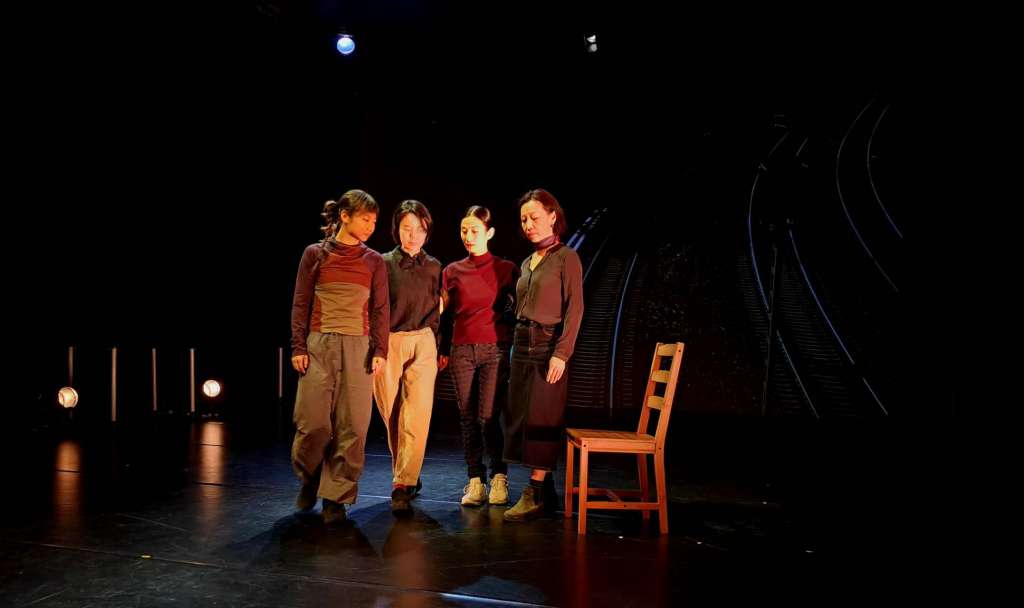
Yumin Ao: How did To Mom, I Want to… come into being? What was the source of its inspiration?
Kefei Cao: I read the poet Yongming Zhai’s Fourteen Simple Songs, written in the 1990s, relatively early. This is a series of autobiographical long poems centered on the “mother-daughter relationship,” which profoundly depicts the complex and delicate emotions between generations of women. In 2018, the poet and I briefly attempted to develop a documentary theater piece based on this long poem. However, due to the pandemic, this project could not materialize. During the pandemic, my collaborators and I produced and exhibited two documentary short films focused on women, based on earlier accumulated footage. At the exhibition, we designed an interactive segment inviting audiences to write a letter to their mothers. Over five months, the exhibition brought in 500+ letters and drawings, which I found truly inspiring. During this time, Deng Zhang, Niannian Zhou, and I had many discussions in Berlin, gradually converging on a shared interest: we all wanted to further explore the universal and emotionally rich theme of “mothers and daughters,” which eventually led to the creation of To Mom, I Want to….
Yumin Ao: As the playwright, how did you collaborate with the Nomadic Minutes team to translate personal experiences into theatrical expression? What materials were primarily used in the creative process?
Jiayun Zhuang: After joining the project, I introduced the theme of “diaspora” into the original framework of “mother-daughter relationships,” hoping to interweave and expand the two themes. This stemmed not only from my own upbringing in a family with multiple migrations—giving me firsthand experience of diaspora—but also because the core members of Nomadic Minutes similarly carry long-standing diasporic histories. I feel that mother-daughter relationships and diaspora are, in some ways, metaphors for each other. The mother-daughter bond is a concrete, everyday manifestation of diasporic experience, while also symbolizing certain traits of diaspora—separation, continuity, and reconnection. The mother represents the origin of emotion and memory, while the daughter’s wandering, drifting, and distancing constitute a continuous response and reinvention of that origin. This relationship undergoes constant rupture and reconfiguration, much like the dynamic between many diasporic individuals and their cultural homelands. Thus, this documentary theatre piece began with the diasporic experiences of the Nomadic Minutes members themselves, while also incorporating narratives about mothers and homelands from ordinary diasporic individuals, collected in collaboration with the Goethe-Institut Shanghai and YOUNG Theatre. Oral accounts, sounds, images, footage, and bodily memories gradually intertwined and transformed through collaboration, forming this theatre work about diasporic lives.
Yumin Ao: In this work, what meaning is ascribed to “homeland”? How does it intertwine with the diasporic experiences of the creators?
Shiyu Liu: For us, “homeland” has long transcended a fixed geographical location—it’s more like a fluid state, carrying experiences of migration, change, and shifting identities. This understanding resonates with our team’s name, Nomadic Minutes. For me personally, “nomadism” is an accurate depiction of my current life—a constant search for belonging between reality and memory. It’s precisely in this process that I’ve begun to rethink the meaning of “homeland” and attempt to imagine it anew. It doesn’t necessarily carry traditional notions of national or familial sentiment; instead, it might be a fleeting intimacy, a shared experience, or an emotional connection forged in a foreign place. Notably, To Mom, I Want to… intertwines our private childhood memories with collective memories unique to specific historical moments. These fragments are reimagined and rewoven, then presented to the audience, inviting them to reflect on their own emotions and echoes of “homeland” while watching.
Kefei Cao: I’d like to add something. The four of us were born in different eras and cities, with upbringings spanning multiple stages of China’s social development. As a result, our perceptions of society and our understanding of “people” vary greatly. Each person’s relationship with their mother is a unique, unrepeatable case. We never intended to generalize these into a single narrative—it’s precisely these differences that create the multidimensionality of this work.
Jiayun Zhuang: Beyond looking back, we can also move beyond the fixation on an “original homeland” and look toward the future, exploring more possibilities of contemporary “diaspora.” Traditional diaspora narratives often revolve around roots, homecoming, and a sense of belonging. But the contemporary context gives “diaspora” a more open and pluralistic meaning. For example, as a digital nomad, my life and work are in constant flux—I don’t necessarily anchor myself to a single country or society, and my identity shifts across multiple temporal and spatial dimensions. So, through this work, I hope to open up another possibility for “diaspora”: understanding it as a self-defined condition, establishing a dynamic, multifaceted dialogue with reality—without romanticizing certain experiences or reducing oneself to the “other.”
Returning to my collaboration with Nomadic Minutes, each member has a distinct background, with differences in values, lifestyles, and even their understanding of theatre. Yet it was under the shared themes of “mothers and daughters” and “diaspora” that we converged. Throughout the creative process, through continuous dialogue and friction, we tried to find the narrative paths each of us wanted to express, the possibilities of embedding our experiences into one another, and the agency that theatre could activate. It was a process of trial and error, but also one of gradually building trust and consensus.
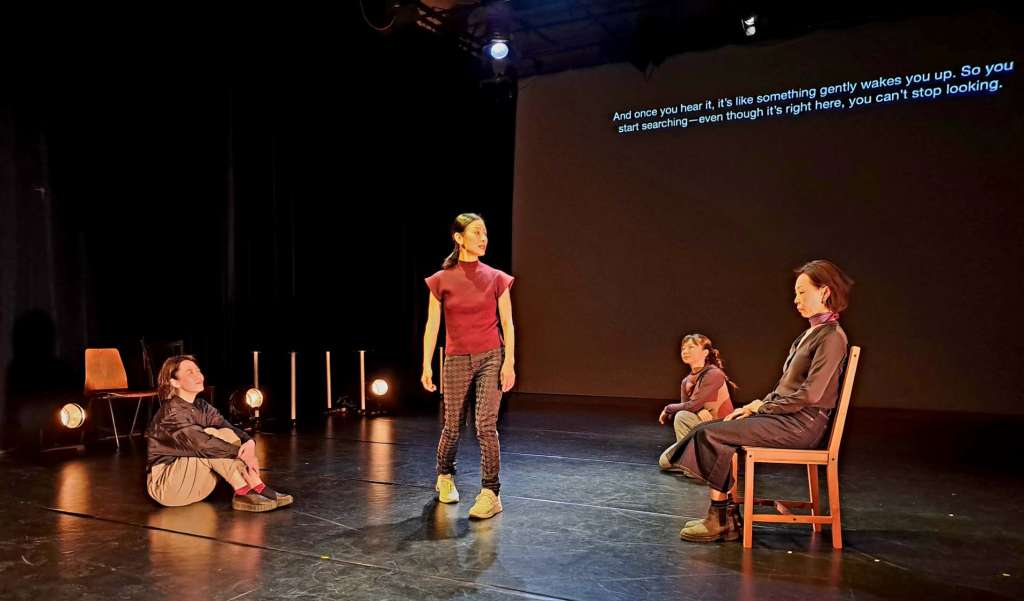
Yumin Ao: How does documentary theatre, as a form, help To Mom, I Want to… convey genuine emotions and complex issues?
Kefei Cao: We didn’t choose to perform someone else’s script—instead, we started from ourselves through documentary theatre. I didn’t consciously shift from being a director to an actor, but this time, I did step onto the stage to personally recount experiences that still haunt me yet must be faced. Through documentation and storytelling, I not only revisited these fragments myself but also invited the audience to examine our growth and the society we inhabit. Documentary theatre opened a more direct path between us and the audience, and I’ve been imagining what echoes this act of narration might stir—both within myself and in the hearts of the audience. That’s my hope for our collective and for this work we’ve created together.
Shiyu Liu: When I first joined this project, I kept asking myself—what exactly is documentary theatre? As a choreographer, my past creative process usually started with a theme, gradually developing it into a full dance-theatre piece. But with documentary theatre, my approach seemed reversed: creation wasn’t about layering but about continuous distillation. Onstage, we kept questioning: What is real? What “truths” are we willing to expose, or must confront?
Yumin Ao: How do the members of Nomadic Minutes balance “self-presentation” and “role-playing” in performance?
Niannian Zhou: Regarding “self-presentation,” I’d like to share some reflections from the perspective of character portrayal. Through repeated rehearsals, I’ve gradually developed a conscious approach to processing and designing both dialogue and physical movements – what began as raw “self-presentation” has evolved into character embodiment and interpretation. By the time we reach this stage, this transforms into full “characterization.” Interestingly, what we call “role-playing” actually contains more intentional “self-presentation” for me. The balance between these two? I’ve learned from our dramaturg, observed through choreographers’ and dancers’ perspectives – using body and movement to layer meanings, create intertextuality, and amplify the complex, ineffable emotional expressions of both “character” and “self.” This approach makes the performance more nuanced and compelling. In several choreographed segments of this production, I’ve consciously experimented with precisely this methodology.
Shiyu Liu: This is a cross-disciplinary work. As a dancer, I once asked myself: Do I have to dance? Is dance the only way I can express myself? In this project, I tried to reconsider dance’s expressive function and its potential for narrative. The four of us come from different professional backgrounds, but that doesn’t mean we’re confined to our original frameworks of expression. Whether through body, language, or thought, each person’s mode of expression is deeply embedded in their own identity structures. In the act of “telling,” they naturally flow together, collide, and generate an open, polyphonic narrative space.
Yumin Ao: As creators born in different eras, how do you view the impact of generational differences on mother-daughter relationships and diasporic experiences?
Deng Zhang: The four of us were born in the 60s, 70s, 80s, and 90s, respectively—our childhoods and the broader societal contexts we grew up in were all shifting. As an only child born in the early 80s under the one-child policy, my family dynamics were inevitably different from Kefei and Niannian’s, who grew up with siblings, and also distinct from Shiyu’s, who, though also an only child, was born in the late 90s when single-child families had long been normalized. These differences are reflected in our work.
Yumin Ao: For each of you, how has participating in this project changed your understanding of your relationship with your mother or your sense of homeland?
Kefei Cao: For me, the most profound change occurred in the way I communicate with my mother. Perhaps with age, we have gradually let go of our defenses and reflexive responses we once had. She’s begun to share stories she once kept silent about—even those that brought her shame—and I’ve learned to listen more patiently and openly. The tension between us has quietly eased, making room for more honesty and understanding. It’s allowed me to re-examine our relationship: no longer just mother and daughter bound by blood, but two people growing closer through time, experience, and emotion.
Shiyu Liu: I admit this process has affected me too, though my situation is slightly different. When I returned to China last year to spend time with my mother, I found myself caught in a tug-of-war between my real self and my creative self—a projection of my own self-doubt. I think deep reflection requires some distance, temporal or spatial; otherwise, it’s easy to descend into chaos, even clashing directly with one’s emotions and creative impulses.
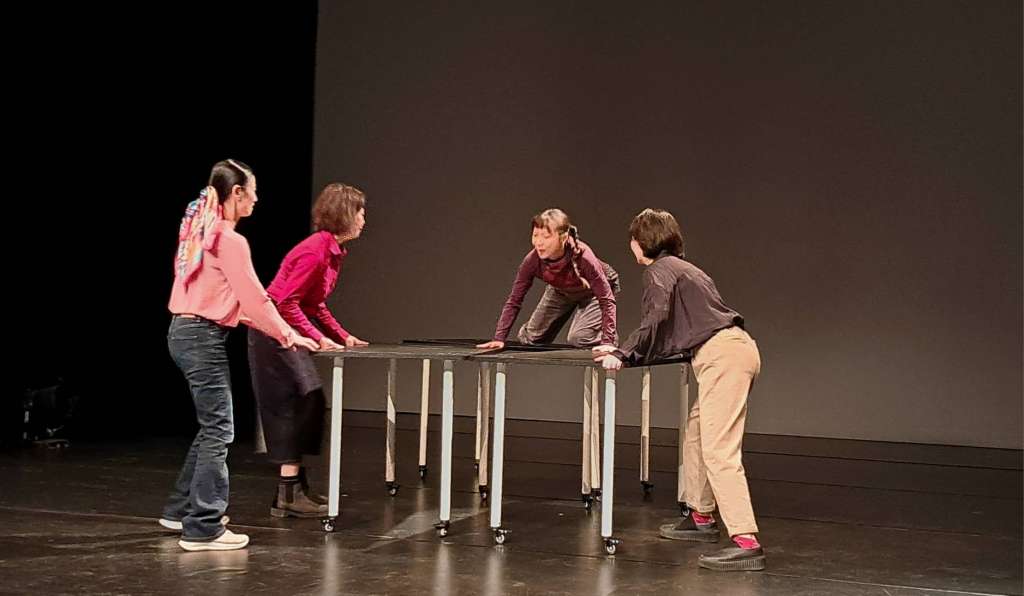
Yumin Ao: Are any members of Nomadic Minutes both mothers and daughters? How has this dual identity influenced the work’s creation or expression?
Deng Zhang: Like Kefei, I’m both a daughter and a mother. I think it’s a universal experience: the moment you become a mother, you gain a new lens to understand your own mother. Questions you had as a daughter start to find different answers. In our creative process, we’ve tried to confront, even chew over these experiences, then reshape them into a theatrical form—hoping to resonate with audiences who’ve lived something similar.
Yumin Ao: Amid the trend of cultural deglobalization, how does the work respond to the uncertainty of mobility? What new meanings does “diaspora” take on in a contemporary context? Does the work attempt to offer a new narrative framework for diasporic communities? What might it inspire in audiences?
Jiayun Zhuang: My time living in the U.S. gave me a particular sensitivity to “diaspora.” Since the Trump era, especially post-pandemic, governance in the U.S. and elsewhere has shifted dramatically. Populism rises, borders harden, and cultural governance turns inward. In this climate of closure, could “diaspora” be reinterpreted as a form of small but potent resistance—fragmented, decentralized, unstable, inherently skeptical of essentialism? At the same time, “identity” has increasingly become a core resource for political and social mobilization. While identity politics and certification respond to real structural oppression, they also, subtly, demand that people define and present themselves in clear, stable terms—a new kind of discipline for those in flux. Still, I want to hold onto a wariness of “essentialization.” This work tries to amplify voices that refuse to be simplified or rigidly categorized.
Yumin Ao: How did cultural exchanges between China and Germany specifically influence the creation and presentation of this work? How does the work provide points of resonance or divergent interpretations for audiences in both countries?
Deng Zhang: From the outset, we envisioned this as a Sino-German co-production. However, with the addition of Jiayun Zhuang and Wenhua Shi, who brought their experiences of living and working in the U.S., the project expanded beyond its original framework to embrace a broader international perspective. Throughout the creative process, we continually grappled with a key question: To what extent are we expressing ourselves authentically, and to what extent are we responding to the expectations of potential audiences?
The work will be staged in both Berlin and Shanghai, and we hope audiences will recognize familiar cultural textures while also encountering distinct linguistic nuances and audiovisual experiences. Accordingly, we adapted certain textual and linguistic elements to each performance context. In Berlin, the production is multilingual—primarily in German, but interwoven with English, Mandarin, and regional Chinese dialects. This approach transforms language into a fluid, polyphonic system of expression, allowing the complexities of identity to emerge more vividly. For the Shanghai version, Mandarin takes center stage, with selective use of dialects to evoke local audiences’ linguistic sensibilities and emotional memories. This linguistic strategy itself has become an integral part of the work’s fabric.
By navigating these cultural and linguistic layers, the piece invites audiences in both countries to locate shared emotional ground while also reflecting on how context shapes interpretation—whether through the prism of Germany’s multiculturalism or China’s rapid societal transitions. The differences in staging are not mere adaptations but deliberate artistic choices that amplify the work’s core themes of dislocation and belonging.
Performance Information
Premiere Date: May 10-11, 2025
Premiere Venue: Ballhaus Ost, Berlin
China Tour Schedule: May 24, 2025, 19:30; May 25, 2025, 14:00
Venue: YOUNG Theatre · Green Box
Duration: 95 minutes
Creative Team
Created by: Jiayun Zhuang & Nomadic Minutes (Kefei Cao, Deng Zhang, Niannian Zhou, Shiyu Liu)
Performed by: Nomadic Minutes
Dramaturgy: Jiayun Zhuang
Stage & Lighting Design: Edwin van Steenbergen
Visual Design: Wenhua Shi
Music Design: Jue Wang
Dr. Yumin Ao, a Hamburg-based scholar, director, and curator, heads the Yingming Theatre Journal and the German Association for Asian Art. She fosters intercultural exchange through organizing festivals, forums, and exhibition projects.
 yingmingtheater.com