The Silhouette of Her: Women’s Self-Gaze and Body Awakening
CH / EN
Interviewer/Editor: Yejia Sun (Columbia University)
Interviewee: Star Yuexing Sun, Etonmars
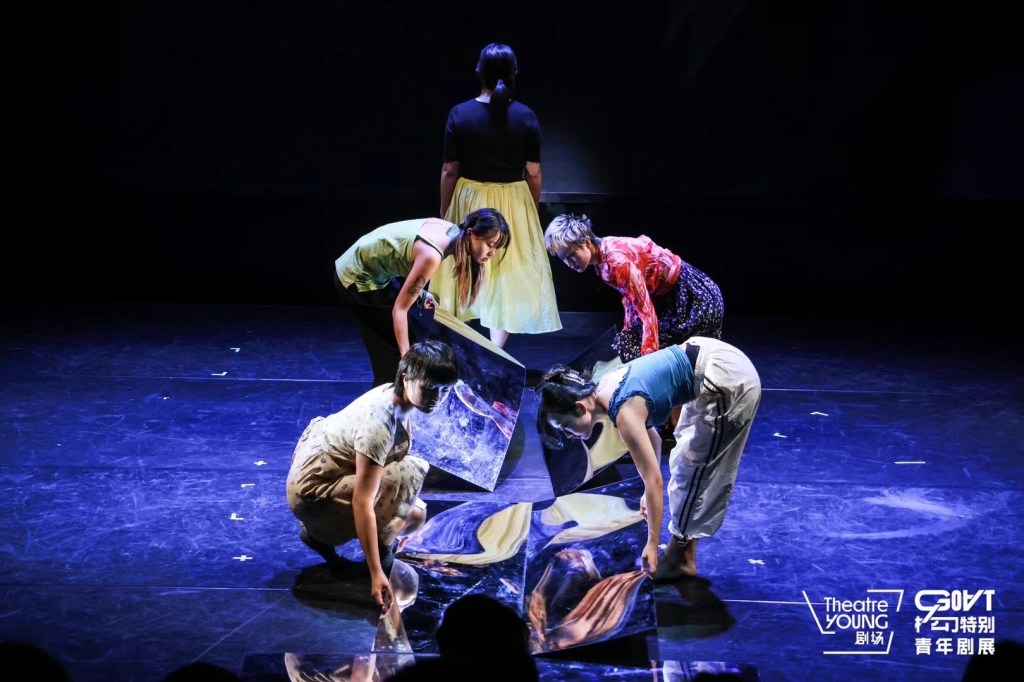
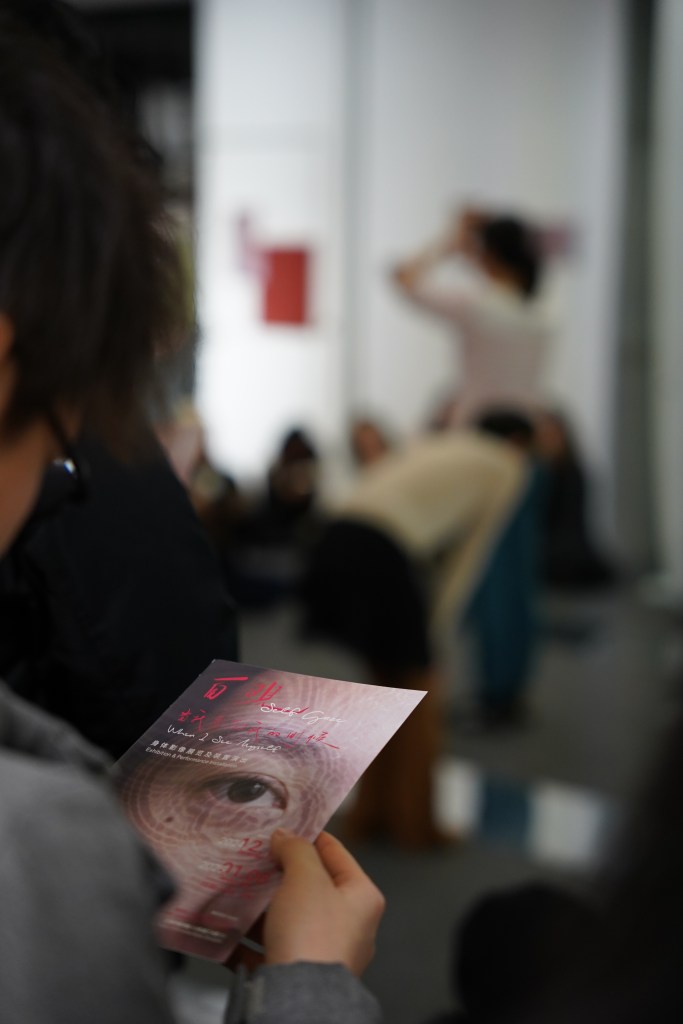
On September 22, 2024, the “Theater in Progress” section of the GOAT Theatre Festival at Shanghai Young Theater featured a documentary theater project of women’s body images titled “Self Gaze: When I Look at Myself.” The topic and the performance resonated deeply with audiences and sparked discussion after the performance. Following this performance, the project is going to be presented as an exhibition and performance about women’s bodies at the Department of Culture and Education of the German Consulate General in Shanghai from December 12th, 2024, to January 8th, 2025.
“Self Gaze: When I Look at Myself” integrates video and theater, originally initiated by Star Yuexing Sun and Etonmars. Beginning in the spring of 2024, the project has involved extensive video documentation and interviews, focusing on women of various ages and backgrounds and their stories about their bodies. It explores the diversity and complexity of women’s bodies and perceptions of them. Through workshops, video exhibitions, photography books, and documentary theater, the project seeks to consolidate these explorations into a cross-media, interdisciplinary art event, forming a sustainable “Herstory” archive. Currently, the project is seeking broader participation from female interviewees. Shortly after the September performance, dramaturg Yejia Sun and the two directors reunited to engage in a discussion about the stories of women and the process of female-led creation featured in the work.
Star Yuexing Sun, Performance Maker
A woman. Born in Inner Mongolia, studied theater-making in New York, and currently based in Shanghai, China. She constantly experiments with storytelling between performing arts and theater, cultural differences between the East and the West, and shifts between director, playwright, sound designer, and performer. Her works often originate from her attention to the details of daily life and her curiosity about the differences between human beings. Using the devising method, her works embrace individual narratives as they confront larger social frameworks swayed by history, identity, and politics. In addition to body movements that are generated from daily life and theater media techniques, she is keen to use cross-disciplinary elements such as photography, music, and documentary to broaden the concept of “theater” and the way to understand the world as a creative. Her ongoing focus is “female identity” and “body language and personal history.” Recent directing works include: documentary theater and installation “Self Gaze: When I See Myself”; Theater fiction “CABIN”, etc. Her works have been widely supported by cultural institutions and projects such as the “Goethe Open Space 2024” of ABTEILUNG KULTUR UND BILDUNG Generalkonsulat der Bundesrepublik Deutschland, the Lower Manhattan Cultural Council, and the Rockbound Museum in Shanghai.
Etonmars, Visual Creative
Etonmars utilizes a blend of imagery and multimedia to explore and challenge the intersections of gender identity, societal boundaries, and their relationship with the inner self. Her journey with photography began in 2006 through blogging, progressively developing a metaphor-rich approach aimed at expanding the definitions of personal identity and artistic expression. Exploration in theatre began in 2013. Her artwork has been featured in group exhibitions such as Seeing HIM: Masculinity Within the Eyes of Female Photographers, Identity Removal System, and La masculinité: Accepting Conflicting, as part of the Antonyms Actronition, advocating for inclusiveness and gender equality. Multimedia performances include Inhale, Heavy Rain. Exhale, Light, Flame and Would You Come Back As You Said You Would.
Sun Yejia, Dramaturg
Sun Yejia is a dramaturg, filmmaker, and writer from Beijing, China, and based in New York City. In New York, her dramaturgical works are performed at National Sawdust, JACK (exponential festival), Chain Theater, The Tank (International Human Rights Art Festival), Lenfest Center for Performing Arts, and Frederick Loewe Theatre. Her playwriting work was featured in the New Play Festival of Cellunova at Theaterlab. She is interested in intermediality, documentary theater, and posthumanism. She is currently pursuing MFA Dramaturgy at Columbia University. (www.yejiasun.com)
Yejia Sun: When did you start working on this project? What inspired you to create this project?
Star Yuexing Sun: The start of this project was very simple. About two or three years ago, when I was still studying in New York, around my birthday, maybe, I suddenly realized that I was about to get out of the “young” category. But I had never truly looked at my body or properly documented it. I rarely took selfies and hardly had any travel photos, so I realized that I had almost zero record of my body’s changes. On that day, I just felt that if I didn’t document it, this time would disappear. However, even though I had the idea of documentation back then, I was too busy with school and work to put it into action. At that time, my body felt very mechanical and exhausted.
By the end of last year (2023), I returned to China and attended a Contact Improv workshop in Shanghai. There, I met Etonmars by chance and learned that she was working on documentaries and photography. Suddenly, everything just clicked—we could start with this idea and do interviews and visual documentation, and that’s how the project began. We first interviewed and photographed each other and officially started in March 2024 when I posted an open call on WeChat to recruit women interested in documenting their bodies for follow-up interviews and shoots.
Etonmars: For me, it was because I had been feeling major changes in my body over the years. When I heard Star’s idea, I remembered that several friends of mine had recently asked me to take nude full-body photos for them. During the shootings for the project, later on, more people expressed their interest in taking nude photos of themselves. It felt like there seemed to be an invisible trend—people were starting to reflect on their bodies and experience a kind of embodied awakening. That convinced me somehow that this might be a meaningful project that needed to be done.
Yejia Sun: From conception to interviewing participants, I’m curious—how did you find these people? And were there any particularly memorable experiences during the process?
Star Yuexing Sun: As I mentioned earlier, we posted an open call and spread the word among our friends and people we knew, which usually went with word of mouth through friends of friends. Initially, most of our participants were people we knew or connected to indirectly. Listening to each person tell their body story was quite special and unforgettable. Whenever possible, we visited participants’ homes to conduct interviews and photoshoots in a familiar and safe environment. The intimate, one-on-one communication in private spaces was rare and special for all of us.
One unique fact was that I was able to reconnect with friends I hadn’t spoken to for quite a while. Through interviews, I learned about their upbringing and personal stories—topics rarely touched upon in our casual conversations that happened before. Everyone was very open and willing to share stories they might never have told anyone before.
One participant from Beijing, LP, left a very deep impression on me. We met at a café in Dongsi HuTong, and surprisingly, she was carrying luggage with her. When I asked where she was heading, she said she was leaving Beijing after our interview. Before, she had quit her stable day job as a primary school teacher in Northeast China to pursue her dream of becoming an actor. That day, she was about to set off for Henan, her second stop on her acting path, to join an improv theater group. The timing was serendipitous—our meeting captured a transitional moment in her life. This gave our project another layer of meaning—since each of them was at different stages in their lives, their bodies and perceptions varied a lot. If we interviewed them again now, their thoughts and feelings might have shifted. Etonmars joked about it after our performance; if she were interviewed now, her answers would be hugely changed.
Etonmars: One of our interview questions was, “Have you ever experienced a moment of body-awakening?” For me, I now feel that my moment of awakening was when I developed a herniated disc (laughs). I’m sitting on two books right now—really funny! The timing changes everything. Visiting participants’ homes felt like creating mini-documentaries about them. We gained comprehensive insights into their life stories and thoughts from childhood to the present.
One particularly impactful story was from an older participant, Menglian, who is in her fifties—around the age of our mothers. During her interview, she shared her experiences with ovarian atrophy and seeking medical care. This topic was unfamiliar to me, which also made me realize that through this project, we can see some problems that we may face in an older age, which are all new discoveries for us.
Star Yuexing Sun: Most of our participants are in their twenties and thirties. We’ve interviewed about 25 people so far, with only a few over forty. We hope to cover more age groups since age is closely tied to bodily experience. As Etonmars mentioned, the focus and concerns about the body vary across different stages of life. When we launched the project, we took a natural and easy approach, so we didn’t set strict goals for participant demographics. However, as the number of participants in their twenties and thirties grew, we started focusing on recruiting people aged 35 and above, as well as those under 20, to expand the age range.
Yejia Sun: You both mentioned earlier that many people were open to discussing their bodies. I think this might be related to how body-related topics have rarely been openly discussed in China. Did you notice any particular phenomena during your conversations or areas where participants were especially eager to express themselves?
Star Yuexing Sun: One phenomenon is that people generally struggle with their bodies. Even though society advocates for modern women to be independent, accepting themselves, and supposedly “awakened,” if we can put it that way. Internally, many still struggle with contradictions and discord. It’s not as simple as shouting a slogan to fully accept one’s body. Past notions persist, and the self-criticism that women impose on themselves to become more beautiful or better selves still exists inherently. In our interviews, one question we asked was, “What is your favorite part of your body?” Initially, the conversation might seem confident and loving for most of them, but when asked the opposite question, people would list areas they feel aren’t good enough or need improvement. This ambivalent mindset is very common among our participants.
Sun Yejia: Yes, I’ve noticed this too—it’s truly ambivalent. It’s like understanding it intellectually is one thing, but understanding it emotionally is another. Because the body is such a private thing—it belongs only to you. Unlike other things, the body cannot be fully controlled or transformed rationally because it’s so deeply connected to emotions and sensations. So, even if we understand certain principles intellectually, the perception and emotional experience of the body aren’t easily altered.
Etonmars: Exactly. As Star mentioned, the ambivalence people have with their bodies is very evident and resonates with many others. Through growth and personal change, people eventually reach their current state of self-expression. We’ve seen their journey of evolving body concepts, which is fascinating. Particularly, we interviewed many peers of ours, and their childhood evaluations and experiences were often quite similar. For example, we asked, “What kind of comments have you received about your body?” and almost everyone gave answers that struck a chord. But I was surprised to find that most people of our age now told us that they’ve accepted their bodies. Initially, I didn’t think this would come so easily, but during the interviews, everyone expressed this sentiment, which left a deep impression on me.
Star Yuexing Sun: What Etonmars mentioned about the “growth journey” is indeed crucial. Even though many years have passed, childhood traumas still have a significant impact on adulthood. Everyone seems to go through this process. Another thing we noticed was that many friends we interviewed had experienced issues like binge eating, purging, and dieting. It made me realize how widespread these problems are. While they might not have affected me personally, they were challenges that many peers had to face—persisting from adolescence to adulthood. Some even grew up in environments where dieting seemed like the only option. For me, as a woman, working on this project has encouraged me to reexamine my perspective—not only to see my own experiences but also to recognize my limitations and understand the broader challenges and trials women face.
Sun Yejia: Yes, during the interviews and rehearsals, I noticed that there was something that a lot of people shared about dieting and purging. Many participants also mentioned their relationship with their mothers, especially their mothers’ opinions on their appearance. This came up repeatedly in the interviews.
Star Yuexing Sun: I remembered when Etonmars and I initially interviewed each other; this topic wasn’t even part of our questions. It emerged from the participants because many would inadvertently mention their mothers when answering our interview questions. We realized it was crucial. The mother is often the closest female body in one’s life, so we decided to add a question about “your relationship with your mother and her influence on you” to our question list.
Etonmars: Or you can say, as a fellow woman, the mother often believes she has absolute authority over how her daughter is shaped as a woman. So, in every aspect—especially how one presents themselves or their body image—she provides guidance or suggestions. This makes me reflect a lot on myself because sometimes, listening to participants talk about their mothers’ biased comments on their bodies, I would recall my mom often saying similar things to me, though I hadn’t noticed before. It felt like this was a very common way of educating children.
Star Yuexing Sun: Yes, there are both highly personal experiences and shared, universal themes in everyone’s feelings. For example, there’s Huaigou, whose mother had severe anxiety about her appearance and figure, so she was extremely critical of her daughter’s looks and body. Or Shanshan, one of our performers, who shared that her mother would pluck Shanshan’s gray hairs whenever she saw them. Even though Shanshan is in her 40s, her mother is still concerned about her appearance—often reminding her not to frown, for example. Later, Shanshan realized her mother didn’t want Shanshan to age because Shanshan’s aging symbolized her mother’s aging—it was an inability to face the aging of herself.
Sun Yejia: Let’s talk about the rehearsal or workshop process. Star, I’m curious—what was the rehearsal process like when working with actors, especially those without professional training?
Star Yuexing Sun: I have a lot to share, so let me start with the casting. We initially wanted to cast two actors based on the theme of the mother-daughter relationship. The actors needed to be independent to tell their own stories and also capable of portraying this relationship. We received about 75 applications and shortlisted 13 to 14 candidates for interviews. We hoped to find actors with a significant age difference, so during initial interviews, we chose two women who fit the mother role.
In the audition, I asked them to showcase their bodies and perform some everyday actions. They were unsure how to express themselves, so they would just repeatedly emphasize how ordinary their bodies were and that there wasn’t much worth showing to other people. For instance, one woman could portray her daughter well, but when asked to present herself, she said there was nothing special about her and seemed a bit not knowing what to do. Another woman mentioned that working a nine-to-five job had gradually confined her writing talent to reports and PowerPoint language, and now this audition experience made her realize her physical expression was also restricted.
Sun Yejia: It’s like the body lost its imagination.
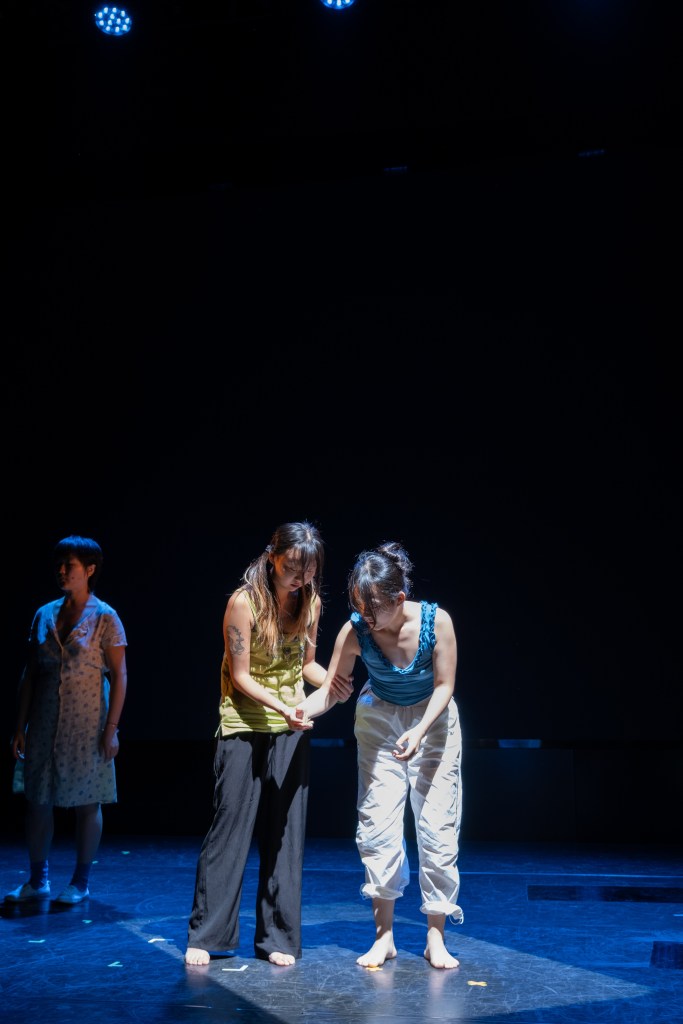
Star Yuexing Sun: Exactly. For the second round of interviews, we invited six shortlisted candidates for a group workshop. Each had unique physical characteristics and represented different facets of womanhood. Ultimately, we made a bold decision to cast all six, though one couldn’t join due to practical reasons, leaving us with five. Among them, Shanshan was the only true “amateur,” though she had some experience in community theater. The other four had varying degrees of performing backgrounds.
For me, the key wasn’t “working with amateurs” but “drawing out the ‘amateur-ness’” in each actor’s experience. In traditional theater settings, actors cannot fully present their true selves while embodying other characters. So what our performance aimed to do was give a chance for them and their real stories. Rehearsals became a process of helping them shed the concept of “performance” and truly see themselves.
Sun Yejia: I recall we explored a cross-media approach during the creative process, integrating elements like recordings, videos, and live performances. How did you intertwine these media?
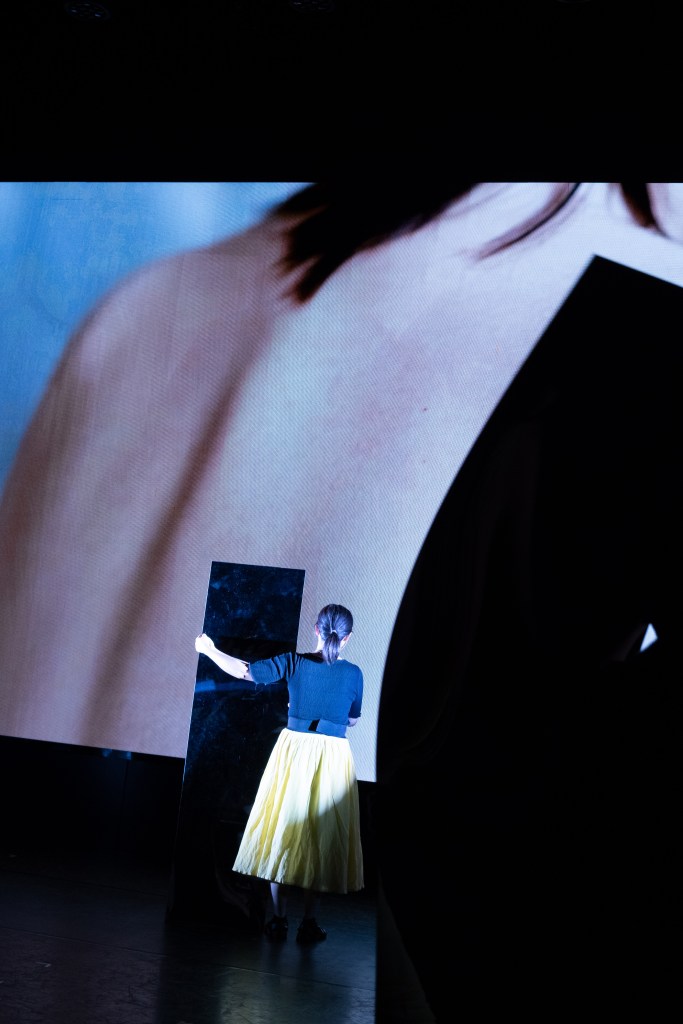
Etonmars: I was mainly responsible for creating stage visuals. My primary task was to choose the right cinematic language for each performer’s story. After discussing with the performers, I designed the visual presentation for each narrative of them. For example, one actor’s story involved a sense of confinement and discomfort, so I used fisheye lenses to create a distorted, enveloping feeling. For another, I employed slow motion to emphasize detachment and dizziness.
We started with a general discussion about the content and then improvised or adapted it during filming. The aim was to collaboratively create visuals that reflected their authentic experiences. The evolving stories inspired the visuals, and I hoped the visuals, in turn, would enhance the storytelling and offer something unique to each actor.
Star Yuexing Sun: Throughout the creative process, we experimented with many versions, exploring how to merge interview material with the actors’ stage presence. Should the actors serve as vessels or narrators of their stories? This was a question we had a lot of conversations about. Ultimately, we decided to blend the recorded real-life stories with the actors’ narratives. In performance, the audience would hear both and perceive their connection. This approach highlighted the individuality and universality of women’s experiences.
Finding the balance between authenticity and performance was challenging. The story existed, but how should it be told? It couldn’t feel overly staged, as that would seem insincere, but it also couldn’t feel like they were just talking to themselves, as that would lack engagement. Finding that balance was a significant part of the process.
Yejia Sun: Right, I remember during rehearsals we talked about how this is essentially a process of subtraction. But at the same time, we needed to ensure that what remained was the most authentic, touching, and consensual content. I remember we also discussed that we weren’t trying to achieve a state of performance or a kind of self-centered narrative, but rather a state of communication. It’s a form of storytelling where the audience is neither an insider nor an outsider, but rather to be positioned in an exchange mode with us. The actors, as equal individuals, share their stories and experiences with the audiences. This is the ideal sense that I’ve come to appreciate—a unique way of creating.
Star Yuexing Sun: Especially since some of the experiences shared were traumatic, we didn’t want the performance to feel like that kind of psychological support group or a complaining session. On stage, we sought to capture the state the actors were in—the hurt and pain had passed, but the marks left on their bodies and minds remained. Now, they can share these experiences with others in a somewhat lighthearted manner. That’s the state we were aiming for.
Yejia Sun: Finally, I want to ask a question, though I think I might already know the answer. Do you think this performance is feminist?
Star Yuexing Sun: It is. Absolutely (Laughs)
Etonmars: (Laughs) Nodding!
Yejia Sun: How do you interpret the feminist perspective in this work? And how do you think it’s expressed in the performance?
Star Yuexing Sun: First of all, I think there are already far too many works, in all forms of art, centered on male protagonists. Men occupy too much space in both culture and society. As a woman, I feel it’s necessary to create works that allow women to speak about their bodies and see themselves through an authentic, self-determined lens. If you ask me to explain feminism, I don’t think I could summarize it very easily, even though I’ve read some feminist books. It’s hard to conclude it in one sentence. I also thought of what Shanshan shared during rehearsals—she said in the past, she often felt like she was born ten years too early. Her peers were getting married, having children, or pursuing high-wage jobs, but after a long period of internal struggle and self-doubt, she decided to let go of this so-called elitist life. Only after she let it go did she realize how she wished she could have made that choice sooner. This experience made her feel the inadequacy of theoretical guidance in practical life. Even though she had absorbed so much feminist and self-awareness education for women, real practice in life was still challenging for her as a woman. The theories couldn’t fully solve the problems of daily life; you have to walk your own path to know.
That’s why I think the process and result of creating this performance reflect observations of our own lives and those of other women, which is truly precious and feminist in its own way.
Etonmars: I feel that this project itself is about starting from ourselves, seeing our own bodies, and enabling more people, especially women, to see their own bodies and the stories they’ve experienced through others. This act itself is feminist. I actually looked up the definition of feminism just now because I couldn’t clearly recall what I’d read before. Feminism often emphasizes equality and the elimination of systemic oppression. In an ideal world, regardless of gender, society would be free of oppression. But in reality, this ideal state doesn’t exist. Because oppression exists, as a woman who is conscious of my gender’s position in society, I hope everything I do is grounded in feminism. For instance, we aim to promote equal perspectives of oneself and others.
Yejia Sun: Yes, I think this can be called a somewhat “embodied” or “practical” understanding of feminism. Many times, these terms seem too general and universally understood, but the core lies in genuinely reconciling with your body. Often, even after reconciliation, there is still discord and struggle. For example, when you look in the mirror, you might think, “Why are my legs so thick?” That thought already carries an oppressive gaze, but you may not realize it, even considering it normal. During a body improvisation session in our rehearsal a few days before the performance, I truly felt the environment without any so-called male gaze or any other kind of external gaze. These five women existed simply as independent individuals. That biological essence couldn’t be expressed in words—it made me feel open up. If we could achieve that state in the process, I think it would be deeply meaningful.
Star Yuexing Sun: Yes, I feel very fortunate because the entire creative process had a natural flow. It wasn’t like setting a goal and striving toward it. Instead, many things naturally emerged during rehearsals. Finding actors who matched us in terms of shared resonance and emotional connection was a wonderful thing.
Once, after rehearsal, an actor asked me, “We feel such deep resonance and understanding among ourselves, but how can we guide the audience to feel the same?” My response was that it isn’t our responsibility to “guide the audience.” Their perspectives are diverse, influenced by personal experiences and their current physical, mental, or life states. I said that the fact we could come together to create this piece was already incredibly rare, and to fully cherish this process would be enough.
Etonmars: I truly feel that our entire creative process, including my work on visuals and our experimentation process, follows a completely feminist approach. From our collaboration to casting actors and the stories they shared after joining the team, everything started without preset expectations. Everyone communicated and shared on equal grounds, and the work gradually formed under this premise of respect. I’ve been thinking about this—our creative approach isn’t like the stereotypical male-dominated directing style, where a director decides every shot and performance until reaching a satisfactory standard. Our method is quite different. For example, Star listens to personal stories and explores possibilities from there with the team. The whole process is grounded in equality and mutual respect, which I think is the essence of feminist creation. It’s hard to put this into words.
Star Yuexing Sun: Yes, words fail me, too. Continuing from what Etonmars said, this performance involves drawing from personal stories, which can be quite heavy. As a director, it’s challenging to guide actors to share and perform without it becoming emotional exploitation. How do we, as creators, empathize while remaining analytical? It’s something to consider.
Yejia Sun: This process is non-patriarchal, or perhaps non-Western traditional, in its approach to theater or art creation. The traditional approach often revolves around one or two creators as the core, with others serving them. We’ve tried to establish an environment without hierarchy. While there may still be leadership roles managing the process, overall, it’s a collaborative and equal effort.
Given our performance’s explicitly feminist themes, I think exploring feminist creative methods during the process has been one of the most valuable lessons for me. Creating such a safe environment is essential to achieving this. This realization has led me to consider how we might align our production process with the values we aim to advocate in future projects.
By the way, one last question—can you talk about the future plans for photography or the overall project?
Star Sun: By the end of 2024, we are going to hold an exhibition at the Cultural and Education Section of the German Consulate in Shanghai, which will be one of the project’s outcomes. The project will include a photo book, an exhibition, and a documentary theater piece. We already have a work-in-progress version of the theater piece, so we’ll focus next on producing the photobook and exhibition.
For the exhibition, we plan to expand on our theme, exploring new related topics and delving deeper into the subject of “women’s bodies.” After the performance, some audience members suggested exploring stories of women we don’t usually encounter—those further removed from our daily lives.
Etonmars: Mostly older women.
Star Sun: Yes, their stories deserve to be told too. Etonmars also mentioned women’s cervical health earlier. We think it could be meaningful to focus on that—interviewing patients and even female gynecologists to learn how they perceive women’s bodies.
We’ve also talked about photographing our families—mothers and grandmothers. Every time I photograph my grandma, she says that in the pictures she looks too old or ugly, but I don’t see her that way at all.
Etonmars: As a photographer, I always say to them, “Why don’t you support me on my projects?” But if I were to photograph my mom, she would insist on putting on perfect makeup and wearing her best outfit first (laughs).
Star Sun: It feels like you travel a long way to hear other people’s stories, but you may eventually want to go back to hear the stories of your own family. There’s a stronger emotional connection there. Maybe this project is helping us prepare emotionally to reconnect with them.
Etonmars: While they’re still alive, I’d like to try. Otherwise, the opportunity might be lost forever. I think we should keep striving toward that.
 yingmingtheater.com